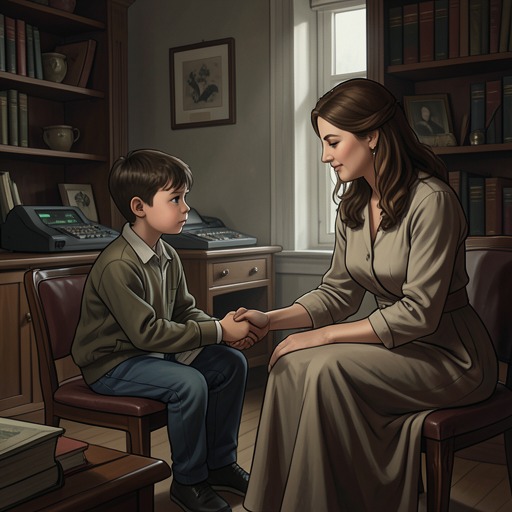
Singer
Of Human BondageSinger’s significance lies in the way he converts Philip Carey’s club-foot from a bodily difference into a weapon of schoolyard power. First curious about Philip’s foot, Singer soon joins other boys in exposing and mocking it; over the term, he repeatedly humiliates Philip and forces him to apologize. Through this unequal relationship, Singer helps establish how peer cruelty and the school’s confined setting intensify Philip’s sense of shame and helplessness.
Identity and Introduction
Singer is one of the boys at the school Philip attends. He first appears at bedtime, when he comes out of his cubicle and asks to look at Philip’s foot. Philip refuses and jumps into bed, but Singer presses the matter, calling another boy, Mason, to join him. The initial curiosity quickly becomes an intrusion into Philip’s privacy and a test of who can control the encounter.
During the school’s playground game of Pig in the Middle, boys discover that Philip’s limp makes him unable to catch the runners. They imitate his movement, surround him, and laugh; one trips him, and the game gives way to a spectacle organized around his disability. The episode establishes the atmosphere in which Singer’s personal harassment takes place: Philip’s difference is already being treated by his classmates as a source of amusement rather than as a part of his ordinary life.
Bullying and Control
At night, Singer and Mason try to pull away Philip’s bedclothes so they can inspect his foot. Philip holds on and asks them to leave him alone. Singer then uses a brush to strike Philip’s hands as they grip the blanket. Faced with further pressure and pain, Philip gives in and puts out his foot. Singer keeps hold of his wrist while looking at the deformity, and Mason comments on its appearance.
The boys flee when Mr. Watson comes upstairs, but Singer’s departure does not undo the humiliation. After the light is out, Singer calls to Philip and receives no answer. Philip bites the pillow to keep his sobbing quiet. What overwhelms him is not simply the pain or the exposure: he is furious with himself for having yielded when he could no longer withstand the pressure. Singer’s coercion therefore leaves Philip struggling with both the other boy’s power and his own sense of having been forced into submission.
A Term of Torment
The harassment continues throughout the term. Singer trips Philip, who is already unsteady, and calls him a cripple. Philip tries to avoid him, but the school is so small that there is no reliable escape. He also attempts to make peace by behaving in a friendly, cheerful way and even buying Singer a knife. Singer accepts the gift without becoming more kindly disposed toward him.
At times Philip strikes and kicks back, but Singer is much stronger. Those attempts do not end the bullying: after being subjected to more torment, Philip is made to ask Singer’s pardon. The forced apologies particularly rankle because they turn physical superiority into a repeated public and personal humiliation. Singer’s youth does not make the situation feel temporary to Philip. He understands that Singer is eleven and will not move up to the upper school until he is thirteen, and imagines that he must endure two years with a tormentor from whom he cannot get away.
Narrative Significance
Singer’s role is limited to Philip’s school experience, but the consequences of that experience are lasting within the scenes described. Philip is happiest when working or in bed, away from the playground and its scrutiny. In bed, he sometimes retreats into the thought that his unhappy life is only a dream and that he will wake in his own little bed in London. The fantasy marks the depth of his isolation: ordinary refuge is scarce enough that escape becomes imaginable only as waking from the life he has been made to endure.
Singer also clarifies the difference between observing a disability and living under its social scrutiny. Philip later blushes when an adult refers to his foot and again when a surgeon identifies its condition in front of fellow students. These episodes are not caused by Singer, but they show that Philip’s embarrassment extends beyond the schoolboy’s mockery. Singer’s sustained targeting gives that vulnerability an early, concrete form: other people’s attention makes the foot conspicuous, while Philip is left to manage the exposure and its effects on how he sees himself.